

Travel Journal · Capri
The Faraglioni of Capri by Boat
Three giants of rock rising from the blue — the image of Capri, never more breathtaking than from the deck of a boat.
From the helm
Every island has its postcard, and Capri's is three rocks in the sea. The Faraglioni of Capri stand just off the island's south-eastern coast, pale limestone giants rising straight out of the water, and generations of travellers have painted, photographed and admired them from the terraces above. From up there, they're a perfect picture. From a boat, they're something else entirely: you're down at their feet, the rock climbs high over your head and the sea changes colour beneath the hull.
The three Faraglioni of Capri, one by one
Each of them has its own name. The one still joined to the island is Stella, also called the Faraglione di Terra, and it's the tallest, at 109 metres. Next comes the Faraglione di Mezzo, the middle one and the smallest, at around 80 metres, with a natural arch opening at sea level. The last, standing farthest out, is the Faraglione di Fuori — the outer one — also known as Scopolo, a name for a headland reaching out into the sea. It rises to just over 100 metres.
A short distance away sits a fourth, lower rock, the Monacone, named after the monk seals that once lived in these waters. As for the word itself, faraglione is thought to come from the Greek pháros: lighthouse.
Carved by the sea, home to a blue lizard
The Faraglioni are limestone, like much of Capri, and they were once part of the island's coast. Over an immensely long time, water worked its way into the rock: the sea hollowed out caves, the caves widened into arches, and the arches finally collapsed, leaving the pillars standing alone in the sea. The arch of the Faraglione di Mezzo is that same story, caught halfway.
Scopolo keeps a small secret, too. It is home to the lucertola azzurra, a rare blue lizard that has become one of the symbols of Capri: a form of the Italian wall lizard, in colours that seem borrowed from the sea and sky around it. Don't expect to spot it from the deck, but it's a lovely thought as you gaze up at the rock: someone up there is dressed in blue.
From the terraces or from the water
On land, the classic viewpoints are famous. From the belvedere of Punta Tragara, at the end of Via Tragara, the stacks seem close enough to touch. From the Gardens of Augustus, the view sweeps from the Faraglioni to the bay of Marina Piccola and the hairpin bends of Via Krupp far below. And from the beaches of Marina Piccola, on the island's southern shore, you see them from farther away, across the water.
They're all beautiful, and if you have time ashore, it's worth seeing at least one: from Marina Grande the funicular takes you up to the Piazzetta, and from there a pleasant walk along Via Camerelle and Via Tragara leads to the belvedere. That way you see the Faraglioni from both sides in a single day.
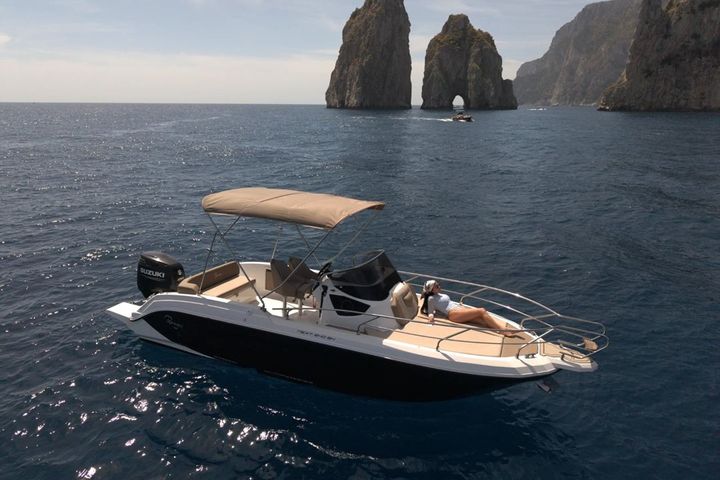
But here is the difference. From land you look at the Faraglioni; from the sea you look up at them. Your skipper slows down beside them and the scale changes completely: sheer walls of pale rock, water shifting from turquoise to deep blue, the arch of the Faraglione di Mezzo like a window of blue in the stone. The light never paints them the same way twice.
Photos and a swim at the Faraglioni
For photos, let your skipper set the scene. As the boat moves, the three stacks slide against one another — apart, overlapping, apart again — and a few metres can change the whole picture. The classic shot is a portrait on the bow with the Faraglioni behind; another is a swimmer in the water, tiny against the rock. When you lean over the side, keep your phone on a strap or in a zipped pocket: the sea keeps what it takes.
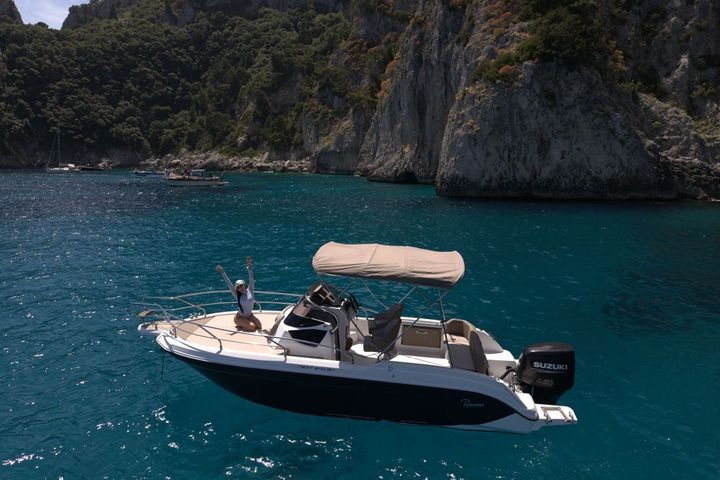
And yes, you can often swim nearby. When the sea is calm, your skipper picks a spot in the area, with clear water and room for the boat, and you dive in with the Faraglioni towering above you. Whether and where you stop always depends on the sea on the day: that's your skipper's call, made with safety first.
How to include the Faraglioni in your Capri day
The Faraglioni are part of our private Capri boat tour: a full day of about seven hours, usually from Marina Piccola in Sorrento (from Positano on request), for your group only. You circle the island — the Faraglioni, the Green and White grottoes, the Natural Arch, the lighthouse of Punta Carena, and the Blue Grotto when the sea and the queues allow — with swim stops along the way, then go ashore at Marina Grande, where private boats land, for two to four hours of free time. The order of the day depends on the sea, and your skipper shapes it as you go. Want Capri and the coast together? The Amalfi Coast & Capri day includes the Faraglioni too. For everything else, read our complete Capri guide and our honest comparison, Sorrento to Capri: ferry or private boat?
Frequently asked questions
Can you see the Faraglioni of Capri by boat?
Yes, and that's where they're most impressive. From the water you see them rising straight out of the sea above you, and your skipper slows down so you can take in the view and your photos.
What are the three Faraglioni called?
Stella, also called the Faraglione di Terra, the only one still joined to the island; the Faraglione di Mezzo, with its natural arch; and the Faraglione di Fuori, also known as Scopolo, home to a rare blue lizard.
Which tour includes the Faraglioni?
Our private Capri boat tour, a full day around the island from Sorrento, or from Positano on request, with free time ashore. You also see them on our Amalfi Coast and Capri day.
Can you swim near the Faraglioni?
Often, yes. When the sea is calm, your skipper picks a spot nearby for a swim; whether and where you stop always depends on the sea on the day.
Ready to see the Faraglioni from the sea?
Tell us your dates — we'll plan your private day around Capri, Faraglioni included.